All posts by Tim

Temperature Trouble, Galvanic Grief and Hydrological Horror

After arriving at Trial Bay Gaol Campground (in Arakoon NP near South West Rocks on the mid-north coast of NSW), we didn’t use the car for a couple of days, there being plenty to do on foot and a fair bit of rain.  On starting the vehicle for the first time after that, it exhibited a number of concerning symptoms.

  1. check engine indicators alight and beeping;
  2. engine temperature gauge beyond the red zone;
  3. a message warning us that cruise control was not available.

check-engine-lightThe engine was patently not warm let alone hot, so “instrumentation error” was top of mind, but that was also the first response to the Apollo 13 oxygen tank explosion, so I called the NRMA. Tom arrived in seemingly less time than the NRMA call centre took to fail to find the vehicle on either of its two(!) computer systems,  telephone the RACV and finally agree that yes, the vehicle did indeed have roadside cover. Tom confirmed with his OBD tool that the engine management system thought the temperature was at extreme levels even though it was not. We located a black-box attached to a radiator pipe and awarded it the “most likely to be the temperature gauge” prize. Its electrical connectors looked clean but I gave them a bit of a rub anyway; that did not clear the fault. Tom checked all the fluids and pronounced the car OK to drive with a recommendation that it be checked by a mechanic soon in case a genuine fault was to occur and go unnoticed. My tentative diagnosis was confirmed.

A couple of hours late, we headed out in the car for our planned day trip. The windscreen was dusty so I gave it a squirt – water from the passenger-side jet went everywhere except onto the windscreen. (“Houston, we’ve had another problem.”) Being extra cautious as a result of the earlier events, we returned to camp to investigate. A few days earlier the rear window washer had failed due to a push-fit pipe join coming adrift, so something similar was assumed. Chewed Water PipeOn inspection, this fault was obviously different: there was hole in one side of the rubber pipe that carried water from the pump to the passenger side sprayer. Looking closely at the hole (with the aid of cameras, magnifying glasses, etc. given the official heritage status of our eyesight) we could see what the folk on CSI call striation marks: parallel grooves, in this case made almost certainly by teeth. Did some animal hop up there while the bonnet was raised in the universal “here I am” signal to the NRMA guy? I asked our neighbours on that side whether they had seen any wildlife displaying a rubber-fetish in our engine bay, but no, they had not. Repaired Water PipeAfter sealing the hole in the pipe with Recovery Tape(*), we rescheduled our day trip to the next day and test-drove the car to the nearest pub. (*) A particular brand of self-amalgamating tape that is even more expensive than generic self-amalgamating tape but if applied according to the directions will not only repair leaks in a radiator or holes in a crank case but will also contain nuclear accidents and ebola outbreaks) Wiring Harness with Vegetables

Having a spare 5 minutes before we set off the next morning on the rescheduled day trip, I had a look around under the bonnet, this time sensibly with the aid of a torch to (refer to earlier comments about eyesight). This revealed some interesting new facts …

  • the black, outer insulation was stripped from a section of wiring harness;
  • chunks of coloured insulation were missing from some of the inner wires;
  • a 5cm length of one inner wire was entirely missing (and later found lower down in the engine compartment) ;
  • a collection of blades of grass and shells from some type of nut;

Undigested InsulationLastly, there were droppings of a size and shape that I recognised from previous crusades against the evil empire that the Romans named ratus ratus. Ever the clinician, Helen spotted a dropping in which an undigested piece of black insulation had been passed. After noting that the insulation on the severed wire was the same aqua colour as that on one of the wires to what Tom and I had previously decided was the temperature sensor, my trusty multi-meter confirmed that they were indeed one and the same circuit.   So, here was not only the cause of the engine temperature “instrumentation error” but a root cause shared with the windscreen washer fault. Whether it is also the cause of the lack of cruise control or air conditioning (did I mention that?) is yet to be determined. We set off for the trip later than intended. The lighthouse at Smoky Cape was nice but the snorkelling adventure was a write-off due to the recent rains pushing copious mud out of the rivers and into the ocean.

The Missing Wire
The Missing Wire

I considered repairing the wiring loom on the spot, but to do so would require removing things I didn’t recognise and may struggle to replace, and we were in what is  best described as a “one tow truck town”. Given that the vehicle is drivable, we will seek expert assistance at our next stop, Coffs Harbour.  We look forward to driving there tomorrow, towing a 2 tonne caravan with the temperature gauge beyond the red zone, the check engine warning lights aglow, no cruise control and no air-conditioning. But it is only two hours away, so could be much worse. If the Ford dealer at Coffs can’t accommodate us this week, I hope to find an auto electrician that will. Otherwise, I will “DIY” it, comfortable that if it goes badly Coffs is large enough to have multiple tow trucks, mechanics and auto electricians, even if that means being forced to stay longer than we had intended in the city that claims to have the most liveable climate in Australia.

Not knowing where the vehicle’s comprehensive insurance policy was comprehensive enough to cover rodent damage but mindful that insurance companies don’t like retrospective claims, I made a coffee, took a deep breath, and made the call. After the advertised human answered the call within the advertised time and then promptly put me on hold, I spent 15 minutes learning about how much they cared about my call,  how they were experiencing an unusually high call volume and how lucky I was to be with them. Eventually “Level 1” answered, reminded me of the policy excess and explained the process of getting the vehicle to their assessment centre etc. etc. After convincing said agent that the vehicle was not in Victoria, that Coffs Harbour was not in Victoria, and that no, the assessment centres in Sydney were not really appropriate, I spent a further 10 minutes on hold,  presumably while a supervisor and/or atlas were consulted. The agent was then pleased to advise me that, there being no assessment centres near the suburb(?) of Coffs Harbour, the assessor would come to the vehicle rather than the vehicle to the assessor. Deciding that even the most liveable climate in Australia would wear thin by the time that happened, I got my reference number and bailed out, making a mental note to locate our policy document and determine whether rodent damage is excluded as force majeure (a term invented by Roman lawyers meaning “Act of God” because saving one word was worthwhile in Roman times, there being so many gods and them being so active). evidence bag Samples of wire, fur and poo have been saved in a clear, zip-lock plastic bag for the CSI team.

Epilogue

The next morning there was a knock on our door. Aforementioned neighbours had packed up and were setting off for their next adventure when their vehicle exhibited a number of warning indicators: no cruise control, no traction control, etc. but fortunately also still drivable. Armed with my information of the previous day, they were able to diagnose the cause somewhat more quickly than I did. Coincidentally, we met again two days later at a caravan park in Coffs, when they had just collected their car from repair and I had just dropped off ours. Suffice to say that the rat contributed a joint total of about $1,000 to the local automotive repair industry …

Mogo Zoo

Mogo Zoo LogoHistorically a gold mining town, Mogo is 10km south of Bateman’s Bay on the Princes Highway. Arguably its principle attraction, Mogo Zoo is 2km east of Mogo on the road to the coast. As with Halls Gap Zoo, it is privately owned, has mostly exotics, and participates in programs aimed at preserving endangered species.

Continue reading Mogo Zoo

Solar Setup

We ordered the van with the maximum number of solar panels that Jayco could fit on the roof, namely three (3) panels of 120 kilowatts each. Unfortunately the other things on the roof (e.g. antenna, air conditioner) mean that there are fewer panels possible than you might expect. Also fitted was a 100 amp-hour deep cycle battery, a Topray TPS-555 1230 Solar Change Regulator and a battery monitor (as part of the SETEC Drifter).

Projecta 600W InverterWe added a Projecta 600W inverter. This is a “modified sine wave” (i.e. not a pure sine wave) inverter with which we run limited mains powered appliances when they are needed off the grid, specifically electric blankets and a small washing machine. We do not attempt to run anything with more current draw than them from the inverter, and certainly not electronic equipment.

In the summer and autumn, the battery recharged by 11am on most days and never fell under voltage. However in winter with limited sunlight hours, the battery did not fully recharge every day, and with cold nights off the grid using electric blankets, the battery did sometimes drop under voltage overnight.

Topray TPS-555 1230Aside from the obvious inconvenience of not having lights etc. until the sun had done its work, driving the battery under voltage uncovered an undesirable feature of the TPS-555 1230 solar charge regulator. When the battery voltage falls below a set threshold, an alarm sounds. Initially we thought there was a cricket loose in the van, such was the chirp…chirp…chirp sound of this alarm. Once the cause was identified we then discovered that this alarm could only be reset by either returning the battery to sufficient voltage, requiring sunlight, or by disconnecting the battery altogether from the controller, requiring a screw driver. There was no other way to silence the cricket that was keeping us awake.

We have addressed these various limitations with some modifications:

  • an LPG heater to avoid use of the inverter on cold nights (see blog post),
  • 1418895786_upload_products_263_300-249_2a replacement solar charge controller (the Victron BlueSolar MPPT 100/30) that includes an alarm reset function amongst many other features and has Maximum Power Point Tracking (MPPT) to squeeze some additional charge from the available sunlight,
  • provision made for a second battery when rewiring for the replacement solar charge controller, which we will add if battery capacity rather than sunlight hours proves to be a limitation (and if not, we will avoid its weight and space).

We gave these modifications, along with the LPG heater and the waste water replumbing, a shake down on a short trip to the Grampians. For updates on the effectiveness of the solar system, watch this space …

Trumatic E 2400 LPG Heater Installation

Revision History

This post has been updated based on experience from 2014 to 2017 – see “Hindsight” section below.

Why?

Soon after starting our caravaning adventures, we got a taste for free or cheap camp sites, not so much for the economics but for the relative peace and beauty of many of the sites around the country as compared to caravan parks. This meant learning to stretch the limited resources (water, toilet cassette, solar/battery amp hours, LPG tanks) in order to stretch the time spent off grid. A mid-winter trip to central Australia with four people in the van and annex emphasised the need for heating at night (despite daily temperatures in the high 20’s). When mains power was available, the reverse-cycle aircon in the van and an electric fan heater in the annex did the job. Off the grid, electric blankets fed from an inverter helped, but left the van battery under-voltage (and once flattened the vehicle battery when I had neglected to disconnect it). LPG is the available energy resource that travels and stores well. (Perhaps hydrogen fuel cells will overtake it soon?) With twin 9kg bottles on the van and refills available at van parks and country hardware stores, it seems that gas should be the last thing to run out. So an LPG heating solution made sense.

What?

Trumatic E 2400 We chose  the Truma Trumatic E 2400 LPG heater. It is designed for RVs by a company with a track record in diesel fired heaters for RVs. Operating on the heat exchange principle, it exhausts the combusted gases to the outside rather than into the van. Internal air is drawn in, passed through the heat exchanger and recirculated back into the van. Various Air FlowsThis heater has four openings:

  1. LPG;
  2. inlet for air to be heated;
  3. outlet for heated air;
  4. combined exhaust gas outlet and external air (for combustion) inlet.
Combined External Outlet & Inlet
Cowl combines external exhaust outlet & air inlet

The last one combines two things into one using a coaxial arrangement, i.e. one is inside the other. This means there is only one external hole and one hose between it and the heater. Aside from reducing the number of holes and hoses, with this arrangement:

  1. the outgoing exhaust gas  pre-heats the incoming air, improving the efficiency of combustion; and
  2. the hotter hose is shielded from combustibles, fingers, etc. by the cooler hose.

This heater can be purchased in Australia for between $1,500 and $2,000. The best deal I have seen offered that includes installation was $1,650 for the heater and $600 for installation (mid 2014.) Tip: If buying online, beware of units that are not accompanied by Australian installation and certification documentation. The gas connection must be done by a gas plumber licenced for mobile installations. The remainder of the installation can be DIY but be aware that you need to be willing and able to:

  • cut and later seal a 70mm diameter hole in your van’s wall,
  • cut at least one 80mm diameter hole in a cupboard wall,
  • do the 12 volt DC wiring and connection,
  • securely mount a 5kg object in a vehicle that moves about.

Having done it ourselves, my opinion is that $600 is a very fair price for installation, especially given that the gas plumbing is likely to cost about half of that. Of course, the $600 offer referred to above was conditional on purchase of the heater from the same supplier: don’t expect to buy it for the best online price and then pay only $600 for someone else to install it!

Where?

Where in the van to install this heater was not obvious. Aside from the space, there are a number of safety and technical limitations. For example, the exhaust cannot be under a window or into an awning, you need a practical pathway for the gas plumbing, there are minimum and maximum lengths for the exhaust and the hot air hoses and there is a minimum separation between the hot air outlet and the cold air inlet. According to a local supplier and installer, under the bed is a popular location, with the exhaust hose going through the bottom bedside cupboard on the driver’s side. However our van has a side-opening boot under the head of the bed and below the side cupboards so (short of running the exhaust hose through the boot) that was not an option. We considered locating the heater under one of the bench seats, but the maximum distance to the outside for the exhaust hose (1 metre) was a problem as it would have had to wind around the HWS and/or the wheel wells.

Chosen Location Showing Hole for Hot Air Outlet

Fortunately, on the driver’s side of our van, between the fridge and the back of one of the bench seats is a stack of three very narrow, very tall cupboards. Of all the cupboards, they are the least useful for storage because of their shape. We settled on re-purposing the top cupboard as home for the heater (and its two boxes of electronics), with the controller/thermostat on the outside of the same cupboard, just above the seat back. With gas already supplied to the (three way) fridge, the gas pipe for the heater could be tee-jointed into the fridge plumbing and brought up through the lower cupboards. Tip. Have your gas plumber to review your intended location and orientation before you commit yourself.  This may cost you a service call, but it is better than cutting a second hole in the wall of the van.

Heater Installed
Heater Installed

This heater can be mounted in a number of, but not all, possible orientations. Factors in choosing an orientation include: where the hoses need to go, their maximum length and, importantly if space is limited, their turning circle (radius of curvature). We ultimately choose the orientation with the exhaust port facing the van wall and the heat vent pointing upward. This was driven by the respective shapes of the heater and cupboard, and by the fact that the turning circle of the heat outlet hose was significantly worse than that of the exhaust hose and so it needed more space in which to make a right-angled bend. If you need a tighter right-angle in the hot air hose than can be achieved with the 80mm flexible hose supplied, have a look at the fittings in the Truma catalogue. As well as a fixed elbow, it shows fittings to suit installations with multiple hot air outlets. Tip. Don’t cut any holes until you are confident that your chosen location and orientation is going to fit. Put everything in place as much as possible, without cutting anything irreplaceable, to prove that your proposed location and orientation is doable. Remember that you need access to tighten screws and the plumber needs access to connect the pipe.

Hindsight (3 years later)

After several years use, we regret putting the hot air outlet so high in the van.  In very cold weather, with the heater on, we have measured a difference of many degrees between the air near the ceiling and the air near the floor.  This means overheated faces but cold feet!

The reasons for this include:

  • hot air rises;
  • the floor of a caravan is less insulated than the walls and roof;
  • in wintry weather, the ground outside is wet and hence the air underneath the caravan is colder than the air to its sides and above.

Combined, these factors mean that the air near the floor needs heating more than the air near the ceiling. If we did it again, would put it the heater’s warm air outlet at floor level, and therefore mounting the heater as close to floor level as practical. Apparently, newer versions of this heater support multiple, distributed warm air outlets.  This seems like a good thing, but based on the above experience, we suggest that it should still be configured so that the majority of the warm air is expelled nearer to the floor than the ceiling. Unless the distribution system enables the flow from each outlet to be adjusted, this still means locating the heater near floor level.

How?

Depending on the orientation, the heater is fixed to its surrounds at either three or four points, using the supplied metal “L” or flat brackets. That does not seem like many mounting points for a 5kg object attached to the gas pipes in a moving vehicle; they need to be robust fixings, as does whatever they are fixed to. Our heater’s vertical orientation meant fixing it at one point underneath it, to the shelf and in two places on the side of it, to one cupboard wall. The gas fitting protruded below shelf level.  We made a replacement shelf from 13mm MDF to avoid cutting the original shelf and to give ourselves the option of starting over if we got it wrong.   To reinforce the cupboard wall, two lengths of 42x19mm dressed pine were screwed (using an excessive number of screws) to that wall. The side brackets of the heater were then fixed to the pine with hex-head timber screws. Tip. A small, cordless screwdriver is invaluable when fixing the heater into a cupboard not much bigger than the heater. We bought one especially for this job, but found it so useful that it has a permanent place in the van. It is much lighter than  a cordless drill, occupies less storage space and has surprisingly good torque. It came with right-angle and offset screwing attachments, which actually work very well.

External Hole for Exhaust

The exhaust requires a 70mm diameter hole in the van wall. This is not the first hole we have cut in that wall, but is the largest (previous was 22mm for an Ezy Eye antenna cable inlet). The position of the hole depends on a number of things, including: location of the heater and interior pathways for the exhaust hose, the profile of the exterior van wall (ours is aluminium with a profile reminiscent of weatherboards) and, less visible but very important, anything inside the wall such as electrical cabling. If you are unsure about whether there is something in the wall, try calling the manufacturer’s customer service team. We have found Jayco to be very helpful in this respect. Given the chassis number they can refer to the layout diagram: whilst it may not include details of actual cabling, they know the principles of manufacture and can tell you which areas to stay away from.

IMG_3654The position of the hot air outlet also deserves some thought. The black, plastic vent supplied has fixed, slanted fins and rotates so that the air stream can be directed. Our outlet is close to the ceiling (see picture) so by directing it sideways or downward, the ceiling is not overheated. You might not want hot air streaming onto your face or body so that might help decide it. Unless you position the heater so that the hot air outlet is flush with the cupboard wall, you will need to use the hose supplied to channel the hot air. Whether or not you use the hose, a hole will be required in the cupboard wall.

Tip. Don’t cut the hoses to length or fix them to the walls until as late as possible. Cut the holes but leave the pipes overlength and loose in the holes. This gives you more wriggle room when positioning and fixing the heater. The cold air inlet can either draw air through a hose (similar to the hot air outlet), or from within the cupboard, in which case the cupboard must be sufficiently vented. We cut down a wooden, rectangular vent and installed it in the door of our heater cupboard (see previous picture). Good quality hole saws are expensive and this may be the only hole you ever cut of this size, so borrow if you can but make sure that it is sharp. Hole-saws drill a pilot hole before the larger hole: this will tell you whether you lined up the inside and outside positions correctly so be sure to check where it came out on the other side before going further. If you are less than one radius out, you get another chance! Tip: Sometimes it can make sense to drill the pilot hole from one side and then cut the larger hole from the other. It all depends on the materials involved, what determines the position of the hole and which side has more margin for error.

Combined Controller & Thermostat

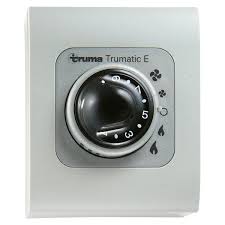
The controller/thermostat can be mounted flush, which requires a 50mm (?) diameter hole in the woodwork, or using the supplied casing, which requires a hole drilled for the cable. The cable supplied is ample in length: where you locate the controller/thermostat is limited by available pathways for routing the cable. We used the casing and put it on the outside of the heater cupboard because that was as good a position as anywhere else. Another advantage of the chosen location for the heater was its proximity to the battery management system, which is under the fridge, and hence to a 12VDC supply. Our unit has some spare, separately fused 12V connections available, of which I used one for the heater.

Results

Cowl Combine Air In and Exhaust Out
Cowl Combines Air In and Exhaust Out

It was late spring when we installed the heater and we have not yet had a winter in which to use it to its fullest. Our coldest morning in the van since installation of the heater was 12 degrees Celsius, so we took the opportunity to try it out. It took 40 minutes to raise the temperature to 22 degrees, which is encouraging.